I use:

Sunday, June 05, 2011

The BlackBerry Bold 9780... with the PlayBook

One of the folks on the CrackBerry.com podcast read my mind when I started using the BlackBerry PlayBook and suggested that the PlayBook makes an ideal complimentary device to the non-touch screen 9780. He's right. It's just as happy as the Torch in the role, but the PlayBook, when linked with the BlackBerry Bridge software, is rich and practical enhancement of the communication suite offered by the BlackBerry Bold.

If you have a BlackBerry already, to utilize BlackBerry Bridge you'll need a device capable of running BlackBerry OS 5, and it should have the latest BlackBerry Messenger (BBM) client. If you have that, you're set and the integration is tight. The PlayBook even tells you when a call is coming in and allows you to silence it remotely. It would be something for the Playbook to allow you to answer a call and use the device as a speaker-phone, but maybe that's not far off, after all, Research in Motion (RIM) is as much about innovation as invention. There are some very smart people there that are working very hard at making a great business tool even better.

Now I just took advantage of the Rogers deal to get a PlayStation3, but that was not my deciding factor in getting a pair of BlackBerrys for myself and my daughter. There are several factors, but the key points are:

  • The BlackBerry Messenger allows certifiable sent, received confirmation so I know, and my daughters know that we've sent the message
  • The data usage is less than other phones out there because of the compression and encryption in place
  • The 9780 (Bold) and 9800 (Torch) have real GPS technology and work with BlackBerry Protect to ensure that the device is locatable, and erasable, remotely
  • BlackBerry phones are tough. I'll recommend a case to anyone, but they are certainly some of the toughest devices on the market
  • The cameras on these devices are great (5 Mega-pixel)
There are other advantages too, but these are the core reasons.

Now, the first thing I did when I received these phones is the updates and core Apps I enjoy for BlackBerrys. Aside from updating BBM and the BlackBerry App World, and installing BlackBerry Protect, the next thing up is Google Maps and the Rogers "My Account" which allows me to track usage (data/phone time) and I show my daughter how that works so she knows how to use the phone responsibly. I also install BlackBerry Bridge for connectivity to the PlayBook. The other very awesome, ad free, app is Poynt. Very helpful when trying to find a place to eat, get to the movies, or just find your way around.
I can't help but think that if RIM created a Bridge application suite for Windows/Mac/Linux to allow this functionality they might be onto something. I'd be very happy to have this connectivity on my Bluetooth equipped laptop or desktop, just like it is on my PlayBook, and the BlackBerry would become the centre of my communication universe. 
Now, my daughter will not have a PlayBook soon, this is driven by my not running out of space on the 16Gb model I won (yes, thank you again RIM) as yet, but the potential is there. As I use this device more, whether shooting awesome video, or taking great pictures (though generally not in low-light), this device is really the centre of my universe both at home and at work. because you can pair the device with more than one BlackBerry, the benefits of the home/work split are clear. You can only connect to one device at a time, but once paired you can switch by simply selecting the appropriate BlackBerry from the list. The data is delivered from the BlackBerry to the PlayBook on-demand.

Now this isn't the only way to communicate with the PlayBook. There's two paths to get information onto the PlayBook, you have WiFi file sharing and you can plug it in and use the Desktop Software to transfer files. The Desktop Software will transcode video files, but I really prefer the WiFi connectivity. When the device is around my house I can connect to it, drop-files on it, back files up from it, all from my Windows desktop PC. I've set the user ID and password, highly recommended, and connect using the devices IP Address. This is NOT as technical as you might think.

I do recommend plugging in from time-to-time to perform backups, it's just a wise move. It's not about device reliability it's about the other factors in life taking away what you really might miss. 
In enjoy the BlackBerry experience, as do my daughters. The Torch is affordable on-plan, and an investment without a contract. PROTECT that investment and install BlackBerry Protect. If you're using a BlackBerry that's on a corporate server, you don't need BlackBerry Protect, your BlackBerry Enterprise Server administrator has the same capabilities and more, but for personal devices, it's my number one recommendation.

The BlackBerry Bold 9780 comes with a 2Gb microSD card, the Torch with a 4Gb microSD card. If you have Windows 7 (I can't speak for Vista) you will enjoy having a Bluetooth connection because once paired with your PC (Laptop or Desktop) you can send those photos and videos to your home system wirelessly via Bluetooth. As long as that PC is on and you're in range (within 30-50ft). Frankly, my 9780 is either plugged in my living room, or in my pocket/backpack (when at work) and unless I need to actually answer the phone my PlayBook handles most of the non-verbal communication. While I have tethered my PlayBook to my 9780, a simple process on Rogers Wireless, I do not use it this way because of the possibility of using so much more data. It's responsive, usable, and if your wireless carrier is as co-operative as Rogers is, it's a wonderful experience. 

Problems?

Rogers was kind enough to originally give me a phone number in Milton, I live in Brampton. Milton is long-distance from Brampton. I call to 1-888-ROGERS1 and a very polite conversation with a very helpful person has corrected this. It seems some of the Rogers people think 905 is 905, and 905 is not 905 but a vast collection of places a long way from each other in an area SURROUNDING Toronto's 416 and 647. If you're making the move from Home phone to Cell Phone as your primary means of communication in the GTA, ask for a 416 or 647 number. I'm now a 647 with assurances that this will not be charged to my bill etc., etc. - We'll see. 

When speaking with any customer service agent don't get angry, calm yourself and understand that sometimes people screw-up, and systems aren't as easy what we'd expect. Talk calmly and politely and be prepared to be on the phone for a while. Explain your self clearly... Do NOT get angry... and never use foul language.
I find that I turn to my Playbook for almost all of my communication, even when a richer experience is available on-line and within reach, because I find it simple, easy to use, and very functional. That said, the BlackBerry 9780 with it's BlackBerry OS 6.0 is very clean, responsive, and just as simple, yet packed into a much smaller area which is not a complaint but a reality with a phone-sized device. It's not a touch screen as the Torch is, but still works very well. I have the advantage of being able to turn to the BlackBerry PlayBook for much of my experience, but the 9780 on it's own is absolutely enough of a device when you won't need even the PlayBook, such as out on the town. That said, I'll load the PlayBook up with travel plans, PDFs, Word Documents, and Spreadsheets that make the trip or outing work better. Planning and preparedness can really help.

I wonder if Joby will create a GorillaPod for the PlayBook? 

I'll be buying the charging cradle for the 9780, and likely the 9800 (for my daughter), as well as the charging cradle for the PlayBook (possibly two... one for the office) but I like being able to just grab and go.

Saturday, May 14, 2011

The BlackBerry PlayBook

It certainly is here, and while it's just a toddler and an a little new to its environment, there's a wisdom in the design and the functionality that has me attached and thoroughly behind the product.

First, let me state, I was given this PlayBook by BlackBerry. I won it thanks to a twitter contest that gave me an option to attend the introduction party in Washington, D.C. and while I was unable to attend, they delivered this unit to me and asked for a review. I am going to give you an honest review.

Further disclaimers, I'm a proud Canadian, and as such have an affinity and interest in the success of RIM and the BlackBerry products, I spent some time in this device's home towns, and I can't help flying the red and while banner when I look this thing over. I'm proud of the effort and the result, as a version 1.0 tablet from a company that's made some fairly tough Smart Phones. Well, BlackBerrys were always just a little different than Smart Phones.

The first impression, though I'll spare you the unboxing pics, is that of a solid device, a comfortable heaviness in the hand, and a solidity that doesn't leave you feeling like you'l break it. The unit turns on right out of the box and while the microUSB charger, pouch and cleaning cloth are helpful, they're a distraction from the device. Locating the power button, a tiny thing that's easy to use, but definitely designed to prevent accident use, on the top edge of the unit beside the volume up, down, and play/pause buttons. It takes a moment to boot up from off, coming to life and getting it's bearings. It needs WiFi to get set up so make sure you have access to signal before starting. It takes you through a brief introduction, some preliminary steps and the first OS update. Expect a few of those over the next few months, as this thing gains the feedback and tweaks the ripples out of the BlackBerry tablet OS fabric. before you meet the OS itself there's a navigational tutorial that ensures you're not lost once it gets to the interface, and you're introduced the BlackBerryID because you need one to make this work. You'll use your own or create one at this time.

You're ready. The interface is simple you have five categories or buckets that contain your apps or sub-sets thereof: All, Favorites, Media, Games, BlackBerry Bridge. I spend most of my time in All, though I've started organising these better and wishing I could have defined my own buckets. You can move the apps around as you see fit and this is initiates with the touch and hold gesture. You put your finger on an app, then leave it there until they start pulsating, then they can be moved within their group, into another bucket, or deleted. The navigation of this interface (as you will have seen in the tutorial) is simple and staring an app is just a finger-tap away, it's comfortably sensitive in this respect. You can also get to the omnipresent settings menu by swiping down from the frame to the screen from the top-left corner this proves useful when needing to connect to WiFi, check the time, battery levels, and get access to settings.

The interface is simple, logical, and convenient, in fact the only miss-steps of the navigation are the odd time the device seems to decide it doesn't want to run an app, yet closing down another app will change it's mind and you're all set, or an inconsistency in the navigational quality when running an app you've found on Blackberry App World. yes, there are quite a few apps, both paid and free, and navigating these is easy.  Selecting All/Paid/Free simplifies the hunt, and the ratings are a good measure of quaility. There have been some very bright developers striving for an early position in this market. To them, well done. Personally, stick with the apps rated 3 or higher, unless you find an un-rated one in which case you're the pioneer. If you like it, go back and rate it, good developers need encouragement.

Getting on typical WiFi, what most people have at home or in travelling, easy. Getting it to work with a reasonably secure corporate network, works well too, which is better than my first experience with an iPad some months ago.

This device is ready for business... and leisure.
The BlackBerry Bridge software could be called tethering lite, but don't tell AT&T because they're very protective of their tethering data plans and we don't want them to throw a fit. I was able to download the BlackBerry Bridge software to me BlackBerry Torch (9800) and my life just got better by an order of magnitude. While the Torch has a wonderful screen and interface of it's own, the integration of the PlayBook's apps serve to make e-mail, BBM, and even file attachments usable, truly usable. When a message comes in on your BlackBerry you get notified on the PlayBook, you can access it from wherever you are through that top-left corner swipe and you're there. You can open a spreadsheet, presentation, word document and use the on-screen keyboard (which is easily hidden if you'd prefer) to make changes. I'd actually started this review on my PlayBook in Word-to-Go, part of Documents-to-Go, while riding the bus to work and it was quite easy to type, I really like the responsiveness of the keyboard!

Full tethering, providing your carrier is not as frustrating as AT&T, is easy to configure, but watch your data usage. I hate surprise phone bills. With Rogers (Canada) it was easily configured and worked well. I then turned it back off... again, surprises are unwelcome.

I run off wireless at home and at work, in fact the BlackBerry Bridge software migrated all the connections I'd configured on my Torch to the PlayBook with no re-entering of these settings aside from my Enterprise configuration which was easily added. The wireless is snappy and reliable, well - if your router is. I'll be buying a new router soon I suspect.

Pushing the "envelope" of functionality. I have tried the following browser-based tools on the PlayBook and while they are seem to work:

  • LotusLive (though opening a mail is a challenge as they use double-click)
  • Genesys Conferencing (screen sharing over-the-web presentation)
  • GMail
  • Google Docs (you need to set it to desktop mode as it thinks it's mobile.)
  • Mercury IT Governance (and I.T. tool for work)
  • Picasa
  • Tungle
  • FaceBook
  • YouTube
And they all work well. LotusLive.com's mail issue was resolved using the keyboard to "press" Enter, but everything was a great experience. 

Videos play well and the videos I transferred that were XviD, MOV, or WMV worked well, some didn't and while the BlackBerry Desktop Software is happy to convert the files, it's all or nothing and when it does it, it's not necessarily as well synced. I need to play more with this and may post a follow up.

Pictures are easily transferred too, it's a simple selection process and then a "sync", as is music. Because the PlayBook is also recognised as a drive when connected (as long as you install BlackBerry Desktop Software first). You may want to look into the Wireless Connectivity but, please, set a password. I'll be playing with this more soon and do a follow-up.

What I did for my pictures was I used Picasa and created albums for the pictures I wanted to move to the device. I intentionally cropped the photos, where possible, to 16:9 and exported them directly to the PlayBook file structure, the cropping and folders created have given me the best possible experience for showcasing this device's beautiful screen. The Picture app that's included does a reasonable job at photo review and has great navigation but when applied as a picture frame lacks looping and timing adjustments. It is definitely not a photo-frame app, it's a picture viewer. This leaves room for the photo-frame apps in the BlackBerry App World, which is where it should be.

The sound quality is great on this device, and video playback is perfect. I popped in xXx, Planet Earth, and the Pilot of Dead Like Me as examples and my 16Gb device is still very happy. I don't download, I do rip, using DVD Ripper from Xilisoft (xilisoft.com) and it works best for this purpose, these same files look awesome on my PS3, PC, and XBOX360. This is now surprise that the BlackBerry PlayBook is delivery awesome, portable media.

The Cameras, yes, there are two.
I haven't play much with these as yet, but the and stills I have taken have been top-notch quality. The cameras are 5 mega-pixel (rear) and 3 mega-pixel (front), which is reasonable in this type of device.


Kobo, the eBook reader.
It's what it should be a good quality eBook reader that I can buy books for and even buy them without a credit card (in Canada too) buy buying Chapters/Indigo gift Cards. It's included, has a good interface and page-turning feel to the navigation. You can preview books (portions of them) and they are delivered to the device. I don't know what happened to Amazon.com's intent to offer a Kindle Reader, but I'd love to see my investment in Kindle Books ($0 in all fairness, though I do have the latest Kindle 3G eReader. I'll review readers later too.

How does this compare to the Apple iPad/iPad2? It's smaller, but that's not all bad. Unlike Steven Jobs, I do like the 7" form-factor. Price-wise it's very similar ($14 less than the iPad) and it does what I need better than the iPad (Flash, enterprise networking). If you are running data through your BlackBerry, you get to take advantage of the data compression and security of the BlackBerry's network design and you get BBM.

I have yet to try the HDMI out, but now that I'm certain I like the device I can budget for the Desktop Rapid Charger, miniHDMI to HDMI cable, and the case. I have ~3Gb left on this device, and once I start playing more with video and the camera I suspect I may need to upgrade to the 32Gb or 64Gb, $599 and $699 respectively. The 16Gb, $499, would go to a very lucky daughter when I get her a BlackBerry to Bridge to.

Overall, a good device, for business or personal use. It's solid, has the right features, and comes with Tetris. It also comes with Need for Speed Underground, but this was my serious review. It's the best tablet I've used and I'm happy to have it. If 16Gb is not enough, I'll by a bigger BlackBerry PlayBook, not an iPad or Android, and this is because I honestly feel it's the best device for me.

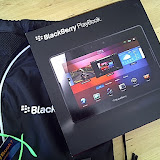
Un-boxing photos:
BlackBerry PlayBook

Wednesday, April 06, 2011

"The Archos 32" or "Why Buy an iPod Touch."

I bought this device for my daughter as an alternative to the more expensive ($249) iPod Touch (8Gb).

Never have I seen one product argue that another product is a better choice than this device. The Archos 3.2 is a $160(+tax) Android device that is not only poorly thought out, but doesn't do what's advertised without a constant fight. If you're not a technical user, and want a personal/portable media device, this device is not for you. In fact, if this device is any indication I'd avoid Archos, and potentially other Android devices, based on this experience alone.

First things first. WiFi does not work reliably on this device, when it's fortunate enough to connect, don't expect much because it can barely handle sourcing music from my Media PC, let alone act as anything more than a clock on it's own.

It doesn't have a speaker, yet they felt in necessary to feature an alarm clock. I bought speakers, they sound great. but what does the device really offer?

The video playback was great, on a 3.2 inch screen, but the player supports a limited number of codecs (transcoders so you can watch movies/videos). As it has trouble dealing with wireless the files had better be local and as there's no additional memory (8Gb max.) you're limited.

The features list for this (and other) Archos devices labelled as "Internet Tablets" suggests that you can connect external media (USB drives), but there's no cable included and no easy means by which to obtain one. I do not consider their web site to be an easy or practical means, and last I looked, it wasn't available.

The Video camera, well camera in general is fairly weak. not only is it at the wrong end of the device, it's not terribly capable. I wasn't impressed at all.

I looked for a single salvation of this device, the ability to play Angry Birds, which is free from the AppsLib.com (like and App Store), but no, the tracking on this tiny screen is so poor you're frustrated and quickly contemplate turning this device into a projectile.

In short, the features, forethought, and quality of this device are an excellent recommendation for the iPod Touch. The iPod Touch... works well, in every way. Consistently.

When asked by a co-worker whether I'd sell him my tested Archos 3.2, I said no. I said go buy a device you'll be happy with. He did, a 64Gb iPod Touch. He is happy.

My Archos 3.2, well I was hoping to use it as a developer device for Android, but rather than frustrate myself. I think I'll drop it into one of my boxes of old hardware to be rediscovered in a decade, then thrown out.

Friday, December 31, 2010

In the Console Wars: XBOX vs. PS3 vs. Wii, what's the best choice?

I've been a Microsoft fan-boy since before I spent a few years working for them. They, generally, have a quality product, and aside from Windows Me, Windows Vista, and Word 6.0 for Macintosh (which is much like Windows Vista's growing pain), they've had a quality offering to the consumer. The same can be said for their game console, it's a quality piece of hardware... Now. It had a rough start with version 1 (circa 2001), and the XBOX360 was cursed by hardware issues and only saved by Microsoft's extension of the warranty to 3 years for the "Red Ring of Death" and the E74 errors. I had two XBOX360's get replaced due to failure, but still the platform is awesome.

Now, I was given a PlayStation 3 for Christmas. I'm not new to Sony's offerings, having had and since given away a PS2 years ago, another fine system that remains available and is, in fact, being integrated into some flat-panel displays even now. The news to me is how much less the TCO is for the PlayStation3 compared to the XBOX360 as it stands right now.

Right out of the box the PS3 has a choice of wired or wireless connectivity to the Internet (your router) and it's a Blu-Ray DVD player. It can connect to your home PC that has all of your [legally obtained] MP3s, DivX movies, and Pictures as shared by Media Player (version 10+/Windows XP and later). You have an ample hard disk (250Gb at this point, though my PS3 is older and has an 80Gb), and all of this is out of the box!

Now the XBOX360 is very similar. The current (as of 2010) model has all of the above with the exception of that Blu-Ray player, but this is not the TOTAL COST of OWNERSHIP... To get online and play against others on the XBOX you need an XBOX Live Gold membership, $60. To attach a camera to the XBOX, you need their XBOX branded camera (~$50) or the new and very cool XBOX Kinect Controller ($150). To get a wireless headset for the XBOX, that's $60. The list goes on...

I am very pleased to see that the following is true of the PlayStation 3.

While the Blue-Ray drive is proprietary and somewhat difficult to source/replace for the technically inept, upgrading the hard drive is... non-proprietary and you can upgrade at your discretion. The camera, if you like such things, can be the same web-cam as you use on your PC. and your headset can be a Bluetooth or USB-connected, and these are not specialized. Also, you get the advantage of a real web browser on the PS3, something the XBOX has needed for a very long time. Oh, and getting online to play others... is FREE. No membership fees. Another easily overlooked advantage to the PS3, the controllers are rechargeable wireless, the batteries may be internal, but you can charge via USB while playing. It's true the XBOX controllers can do this, but you pay a premium for the controller then need to supply your own batteries or get a battery pack.

The choice of games systems is tilted in favour or the PS3, the final influence is the games you want to play. There are Microsoft-only properties, and Sony-only properties. You can't play any of the Halo or Forza games on the PS3, but you can't get GT5 on the XBOX360...

Oh, I didn't mention the Wii... I did say BEST choice. Personally I use the Wii for Netflix, but it's a good low-cost system that has fun games for kids.

Thursday, October 21, 2010

Apple (Canada) - MacBook Air - The next generation of MacBooks.

Apple (Canada) - MacBook Air - The next generation of MacBooks.

This is a problem. The Mac product line has been enhanced with the addition of the Macbook Air. The 11 and 13-inch wonders from Apple have me in a position of great conflict. On the one had this is a Macintosh, and Apple product, that is a remarkable work of technical art. They've produced technical art for years and are quite good at it. On the other hand it's an Apple and while I'm wondering about the sanity of the great Steve Jobs, especially after that most recent earnings call, the company's over-priced approach to proprietary technology, their technical arrogance, has bothered me for years.

The bottom line is that my conflict has been, for years, that Apple doesn't work and play well with others and while their products are nearly bulletproof from an operational stand-point, they remain closed-minded. Shamefully, I have recognized for some time that the benefits of closed-mindedness is that the system is incredibly stable and when it becomes unstable the responsibility falls squarely on Apple's shoulders. The thing is, they have taken on this responsibility quite well. My only argument against Apple, now, is the price... okay, was.

The new Macbook Air, and indeed the existing and wonderful Mac Mini, are examples of affordable personal computing awesomeness. A laptop that's stable, virtually un-threatened by viruses, and has Mac reliability for about $1000 is a good choice.

Now, don't get me wrong, I still feel that there is evidence that some of the Mac Users are delusional and they've set up in Apple's camp from a strictly non-technical standpoint. I also feel that if you need an economical PC that looking to a Windows-based system is going to cost you less, but I must stop myself from being Anti-Apple and admit to you, and everyone else that these new products, in fact many of their products right now, are amazing devices.

The iPhone, iPad, iPod Touch and Nano, the Mac Mini, and the new Macbook Air products offer a wonderful experience for the user, the consumer and as creativity tools. The use of any Apple product in an enterprise, for business, is another matter. For business, the reality remains that the BlackBerry and the Windows-based PC is the right choice, but that's another story.

A tribute to the durability of at least ONE Apple product:

Friday, April 16, 2010

Pogoplug: NAS Improvisation with a Social Media Twist

On April 15th, 2010, pay day, I picked up a necessary new tool in data security, the Pogoplug. It is not a Network Attached Hard Disk, but a facilitator to helping your various USB 2.0 Storage Mediums become Network Attached Storage.

The first thing you will notice is the colour, it's hot pink! That aside, and real men can put that aside, it's a well-designed device with an Ethernet jack (RJ-45), 4 USB ports (1 on the front), and a very secure power-plug. They advertise a 60-second setup, they're not wrong though I'm unsure of the need for some of the Social Network nuances (connectivity to your Twitter, MySpace, and Facebook accounts for updates). The next thing, if you have an iPod, PS3, or XBOX360, is that whatever media you connect to this sweet little device becomes available to stream to these remote media devices. It was quickly recognised by my XBOX360 allowing me to, finally, excuse my primary PC from this menial task. The poor little box also transcodes video so that it's compatible for other devices, though I'm not certain this would help your XBOX play your iTunes collection, we'll see.

Security is provided through their website, https://my.pogoplug.com, and you will want to ensure this password is secure, you can potentially access all of the connected physical media from any web-connected PC in the world. While it has the ability to share other folders, be careful about this and please do NOT post copyright protected materials for everyone and their brother.

I'm going to explore this device more over the next few weeks, but I'm starting of the stress-test of backing up all of my backups. I connected a very nice 1Tb hard disk I picked up at TigerDirect.ca for $90 (a good deal) and a 16Gb USB Key that I recently acquired from Staples. The Windows software provided (via download) allowed the Pogoplug to appear as a physical drive, the connected devices are presented as folders based on their hardware identity (i.e. SanDisk Cruzer, SAMSUNG DF1H32), though you can rename these through the web interface. You can also grant access to the device through SSH, that I'll explore later too.

Stats (As I find them):
Copying from a network resource to the Pogoplug, same network: 88.133 MegaBytes/min
(Robocopy of 28Gb over 5:35h)